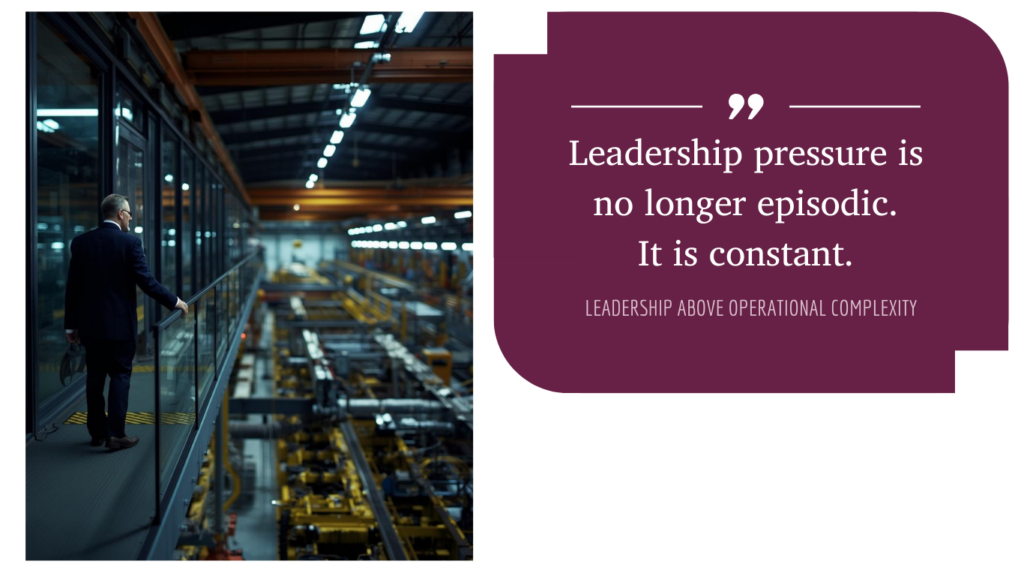
In UK manufacturing, leadership pressure is no longer episodic.
It’s constant.
- Margins are tighter.
- Cost inflation hasn’t fully unwound.
- Supply chains remain fragile.
- Labour is harder to find and harder to keep.
Most leadership teams are operating with less slack than they’ve had at any point in the last decade. And yet, when a senior appointment is made, we still tend to lean heavily on the same comfort blanket.
- Proven experience. Strong CV.
- Done the role before.
- On the surface, it makes sense.
In reality, it’s one of the most common reasons leadership hires quietly fail.
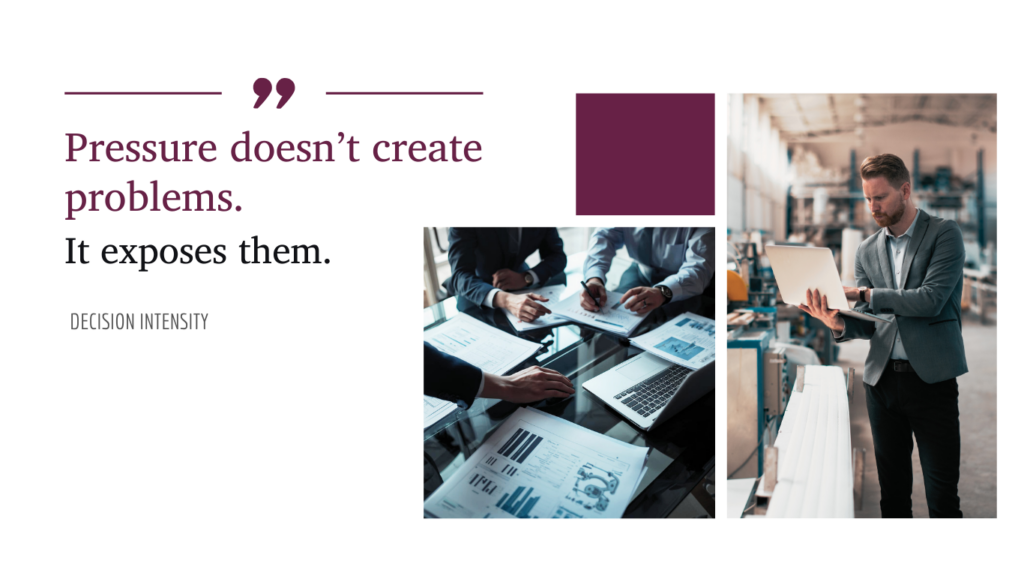
Pressure Doesn’t Create Problems. It Exposes Them.
Most leadership failures don’t begin with incompetence.
They begin when pressure increases and behaviour changes.
When the load rises, leaders don’t suddenly become different people. They revert to type.
- What was once manageable becomes revealing.
- Some tighten decision-making and pull work back towards themselves.
- Some stop listening because speed feels safer than dialogue.
- Some retreat into data, dashboards, and process because numbers feel controllable when people don’t.
None of this is malicious.
Most of it is unconscious.
From the outside, the business still looks managed.
Meetings still happen.
Reports still go out.
But underneath, leadership bandwidth narrows.
Decisions slow. Ownership blurs. Energy drops.
By the time performance visibly moves, those shifts have usually been in place for months.
Experience Isn’t Transferable. Behaviour is.
This is where many executive appointments go wrong.
We over-weight what someone has done before and under-weight how they actually behave when the environment changes.
Two leaders can have almost identical CVs and respond completely differently under pressure.
One creates clarity, delegates decisively, and keeps dialogue open.
The other becomes the bottleneck.
One expands the capacity of the team around them.
The other unintentionally constrains it.
The difference is not intelligence.
It’s not effort.
It’s judgement, values, and decision-making under load.
A CV will tell you where someone has worked and what they were responsible for.
It tells you very little about how they behave when the cost of being wrong is high.
Why This Matters More Now
Manufacturing businesses today don’t have the luxury of long bedding in periods.
Leadership error no longer shows up as dramatic failure.
- It shows up as drag.
- Missed decisions.
- Delayed action.
Good people spending time managing around a leader rather than being led.
In this environment, the cost of a mis-hire compounds quietly.
Six months become twelve.
Twelve become eighteen.
And before long, the organisation is back solving the same problem again, often at a higher cost and under more pressure than before.
The CV Problem
Traditional executive assessment is heavily weighted towards what is visible and defensible.
- Career progression.
- Sector relevance.
- Scale of role.
- Technical competence.
All of that matters. None of it is enough.
The real risk sits underneath.
- How someone handles ambiguity.
- How they respond when challenged.
Whether they seek control or create space.
Whether they listen when it’s uncomfortable.
These things rarely show up in interviews.
They don’t appear in references. And they are almost never tested properly before appointment.
How Leadership Failure Actually Happens
Most leadership hires don’t fail loudly.
- They don’t implode in the first 90 days.
- They don’t make obviously bad decisions.
They fail quietly.
- The team adapts around them.
- Decisions move slower.
- Issues escalate more often.
- Energy drains incrementally.
By the time it’s acknowledged, the organisation has already absorbed the cost.
How We Look at Leadership Risk
This is why we focus on behaviour under pressure, not just experience on paper.
At TS Grale, that means understanding how a leader actually operates when the environment tightens:
- Do they centralise or delegate?
- Do they ask questions or default to answers?
- Do they stay present or retreat into process?
- How do they behave when control starts to slip?
EVOLVE exists for this reason.
Not as an abstract leadership model, but as a way of getting underneath the CV and into values, judgement, and decision-making before pressure exposes them at scale.
It allows us to see risk earlier.
And, just as importantly, to understand where a leader will add disproportionate value.
Certainty Beats Potential
In a stable environment, potential can be developed.
In a pressured one, certainty matters more.
That’s true whether the solution is interim leadership to restore control quickly, or a permanent appointment designed to protect long-term performance.
In both cases, the question is the same:
How will this person actually behave when it gets busy, messy, and uncomfortable?
The Uncomfortable Truth
Most businesses don’t suffer from a shortage of capable people.
They suffer from leadership decisions made with incomplete understanding of behaviour under pressure.
Get it right and performance compounds quietly.
Get it wrong and the cost is rarely short-term.
By the time it’s visible, it’s already expensive.